A Look Back on Our USDA Specialty Crops Research Initiative Grant: “Investigating the genetic basis of downy mildew and bacterial leaf spot resistance in basil (Ocimum spp.) using advanced genomic techniques.”
As we near the end of the USDA Specialty Crops Research Initiative Grant entitled “Investigating the genetic basis of downy mildew and bacterial leaf spot resistance in basil (Ocimum spp.) using advanced genomic techniques,” we wanted to take a look back at the state of the basil industry in 2022. You can see previous stories highlighting the grant here and here. A major goal of this grant was to develop genetic tools to address multiple growing issues in the basil industry: bacterial leaf spot and basil downy mildew.
Bacterial Leaf Spot (BLS)
In 2022, only two major diseases were affecting basil: basil downy mildew and bacterial leaf spot. Bacterial leaf spot caused by the pathogen Pseudomonas cichorii, was a more ephemeral and location-dependent problem. Even though this is the case, as the years have passed, more and more growers have reported this problem. This increasing number of unique and disparate growers reporting his disease is concerning, and this problem needs continued action. Our team has developed new high-throughput screening methodologies to identify basil varieties with resistance or tolerance to this new disease. Our recent publications can be found on this website here but the original publication can be accessed at the ASHS HortScience website (DOI: 10.21273/HORTSCI18156-24). 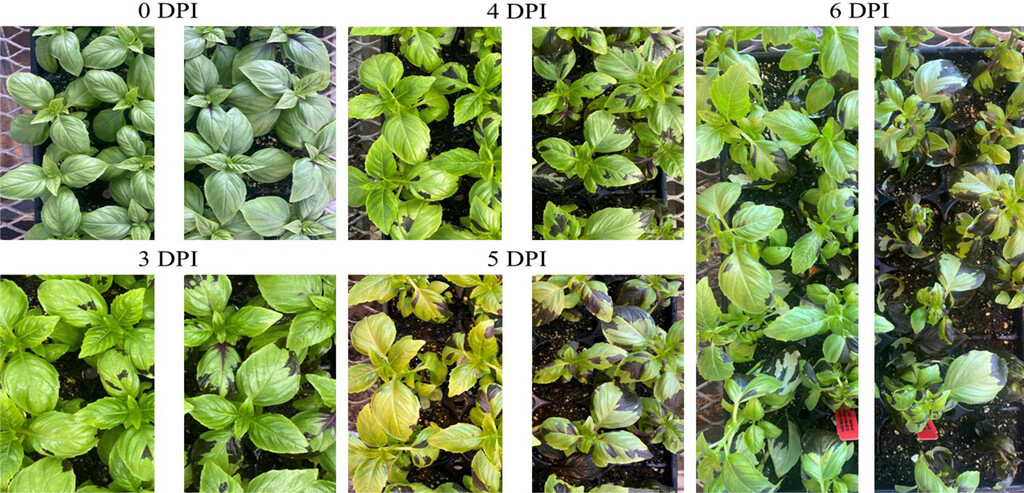
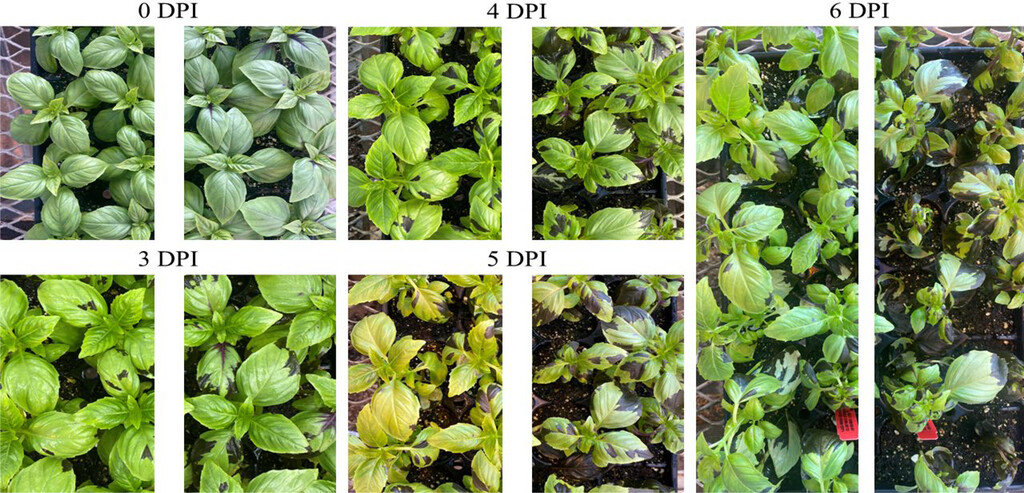
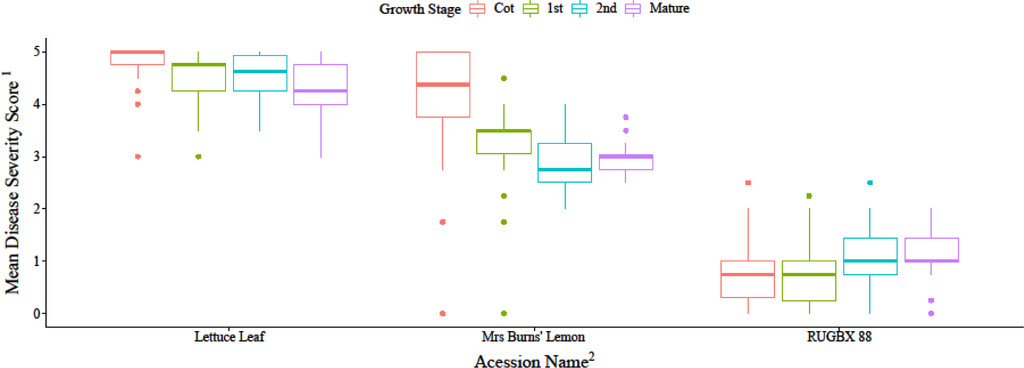
As you can see in our first image, our screen shows bacterial leaf symptoms at 3 days post-inoculation (3 DPI) and they progress drastically from there. From the figure below you can see the mean disease infection score across three varieties. Lettuce leaf basils tend to be highly susceptible to this disease, while the exotic RUGBX-88 from the IPK Germplasm bank was one of the top performers in our initial screen. Also our team identified that the cotyledon stage was sufficient for our screens, allowing successive screens to be done in less time.
The State of Basil Downy Mildew (BDM) in 2022
Basil downy mildew remains the most problematic biotic disease of basil. At the start of our 2022 USDA-SCRI grant, only a few resistant varieties and chemical controls were available. The team at Rutgers had developed and released the Rutgers Obession DMR, Rutgers Passion DMR and Rutgers Devotion DMR varieties. These generally displayed strong resistance and only broke down towards the end of a long growing season, when disease pressure was at its highest. The Prospera series from our team at Bar Ilan University was performing extraordinarily well with no disease symptoms throughout multiple growing seasons; however, this started changing in 2022 and 2023, with all Prospera varieties displaying serious disease, basically as if they had no resistance at all. This posed a seriously challenging and dangerous idea: is the disease changing so rapidly that our resistant basils will no longer be resistant in a few years? And if it is, what does the population structure of P. belbahrii look like? Our 2022 grant sought to answer some of these questions. We are currently awaiting an answer from an academic journal on our investigation into the population structure of P. belbahrii; however, a major takeaway is that for an asexually propagated pathogen, there is a surprising amount of genetic diversity.
New Races of BDM
All of the B.A.S.I.L. teams have been working to develop new, strong and durable resistance lines to basil downy mildew. Since the USDA-SCRI began in 2022, our group has released a new selection of varieties called the Prospera Active series. These varieties were bred to contain an additional resistance gene stacked with the previously identified resistance gene in the first generation of Prospera cultivars. This was highly promising and showed strong initial results; however, in 2024, this resistance seemed to already be breaking down. Regarding basil downy mildew evolving — spoiler alert: our research indicates there are at least 3 strains that cause variable disease on different resistant varieties. Our preprint on biorixv shows that we believe there are three ‘races’ – race 0, which causes disease on standard sweet basil varieties but cannot overcome Rutgers DMR or Prospera resistance. Race 1, which causes increased disease on Rutger DMR lines and completely overcomes Prospera lines. Race 2 was defined as causing minimal disease on Rutgers DMR lines but completely overcoming the newly developed Prosepra Active lines that contained a new resistance gene.
Looking to the Future
Although significant advancements have been made throughout this grant period, with new varieties, techniques, and screening methodologies identified for both bacterial leaf spot and basil downy mildew, our industry still remains highly threatened by both diseases. We’re dedicated to continuing to address these major concerns and have more resistant sweet, thai and lemon basil varieties in the pipeline for release in the near future.